Architecture
This image runs a Tribes 2 (2002, Dynamix “V12”/Torque-lineage engine) dedicated server under Wine on the .NET runtime base image, with an ASP.NET Core 10 control panel that owns the whole thing.
The big picture
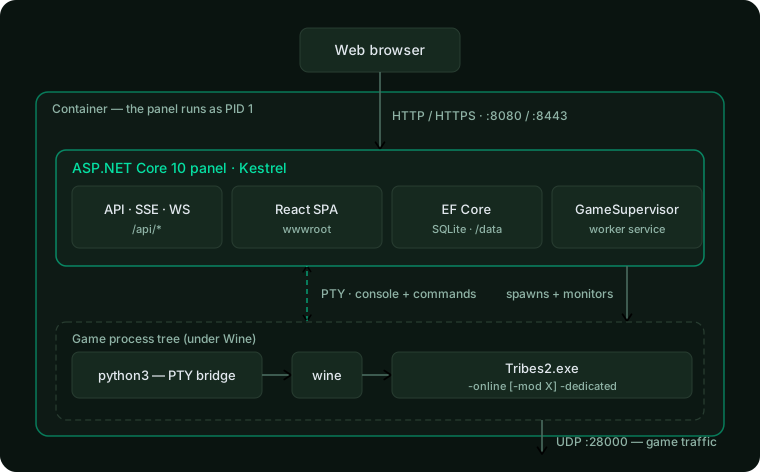
Why the panel owns the game (not the other way around)
The container’s entrypoint is the panel, not the game:
ENTRYPOINT ["/usr/bin/tini", "--", "dotnet", "/app/panel/TribesServerPanel.dll"]
That single decision drives the design:
- The panel survives game crashes/stops. If the game dies, the panel is still up to report it, restart it, or let an operator investigate. (If the game were PID 1, a crash would take the container down and you’d lose the console/UI.)
- The game runs as a child Worker Service (
GameSupervisor), which starts/stops/restarts it, watches for unexpected exits, and records crashes. tinireaps the Wine process tree so there are no zombies.
Components
ASP.NET Core panel (panel/)
Program.cs— composition root: Kestrel/TLS, EF Core + Identity, authorization policies, DI registrations, WebSockets, static files + SPA fallback, endpoint mapping.- Endpoints —
Endpoints.cs(account/console/server/config/users/audit/crashes),FileEndpoints.cs(file browser/editor/upload + revert),TerminalEndpoints.cs(root container terminal). All Minimal APIs. Services/GameSupervisor.cs— the hosted service that launches and supervises the game.Services/ConsoleHub.cs— a ring buffer of console lines + live fan-out to SSE clients.Services/TerminalSession.cs— the PTY-backedbashbridge for the root terminal.Services/FileAccess.cs— path scoping for the file browser (GameData vs anywhere).Data/— EF Core entities +AppDbContext;Bootstrap.csseeds/migrates.Auth/— Identity user/role types and the rank-basedRolestable.Tls/TlsConfigurator.cs— self-signed / Let’s Encrypt / plain HTTP.ClientApp/— the React + Vite + TypeScript SPA (built towwwroot).
The game under Wine
- 32-bit Wine prefix at
/opt/wineprefix(WINEARCH=win32). - Game data at
/opt/wineprefix/drive_c/Dynamix/Tribes2/GameData(GAME_DIR). - The community QoL patch is overlaid at build time (its modern features live in
IFC22.dll). See Internals. - The game is PE-patched from a GUI app to a console app and driven on a pseudo-terminal so it runs headless without xvfb. See Internals.
The supervisor loop
GameSupervisor (a BackgroundService) runs a simple desired-state loop:
- On startup it reads
ServerSettingsfrom the DB. The game launches only if the server is configured and Auto-Start is on (see Web panel & roles). - While “run” is desired and the process isn’t alive, it spawns the game (via the PTY bridge),
composing the final command line:
wine Tribes2.exe <LAUNCH_PARAMS with -mod inserted>. - If the game exits unexpectedly (not an operator action), it records a crash report and (by default) restarts after a backoff.
- Operator actions — restart, force-restart, stop — set the desired state and either ask the
game to
quit();gracefully or kill the Wine tree.
Data flow for the console
- The game’s stdout/stderr (on the PTY) is published line-by-line to
ConsoleHub. - Browsers subscribe via Server-Sent Events (
GET /api/console/stream). - Commands typed in the panel are written to the game’s stdin on the PTY.
Request/auth flow
- The SPA calls
/api/account/login; ASP.NET Core Identity sets an HttpOnly cookie. - Subsequent API calls carry the cookie; endpoints are guarded by rank-based policies
(
User < Admin < SuperAdmin < root) plus the orthogonal Developer capability for file editing. See Web panel & roles. - The SPA uses client-side routing (React Router); the server serves
index.htmlfor unknown non-API paths (MapFallbackToFile).